Revocation & CRL/OCSP
Revoking a certificate in Sectigo Edge is immediate and permanent. Sectigo Edge then publishes the new status to relying parties, through a certificate revocation list (CRL) and through pre-produced OCSP responses. Revocation and publication are tracked separately: if publication is briefly unavailable, the certificate stays revoked and publication is retried until it succeeds.
Revoke a certificate
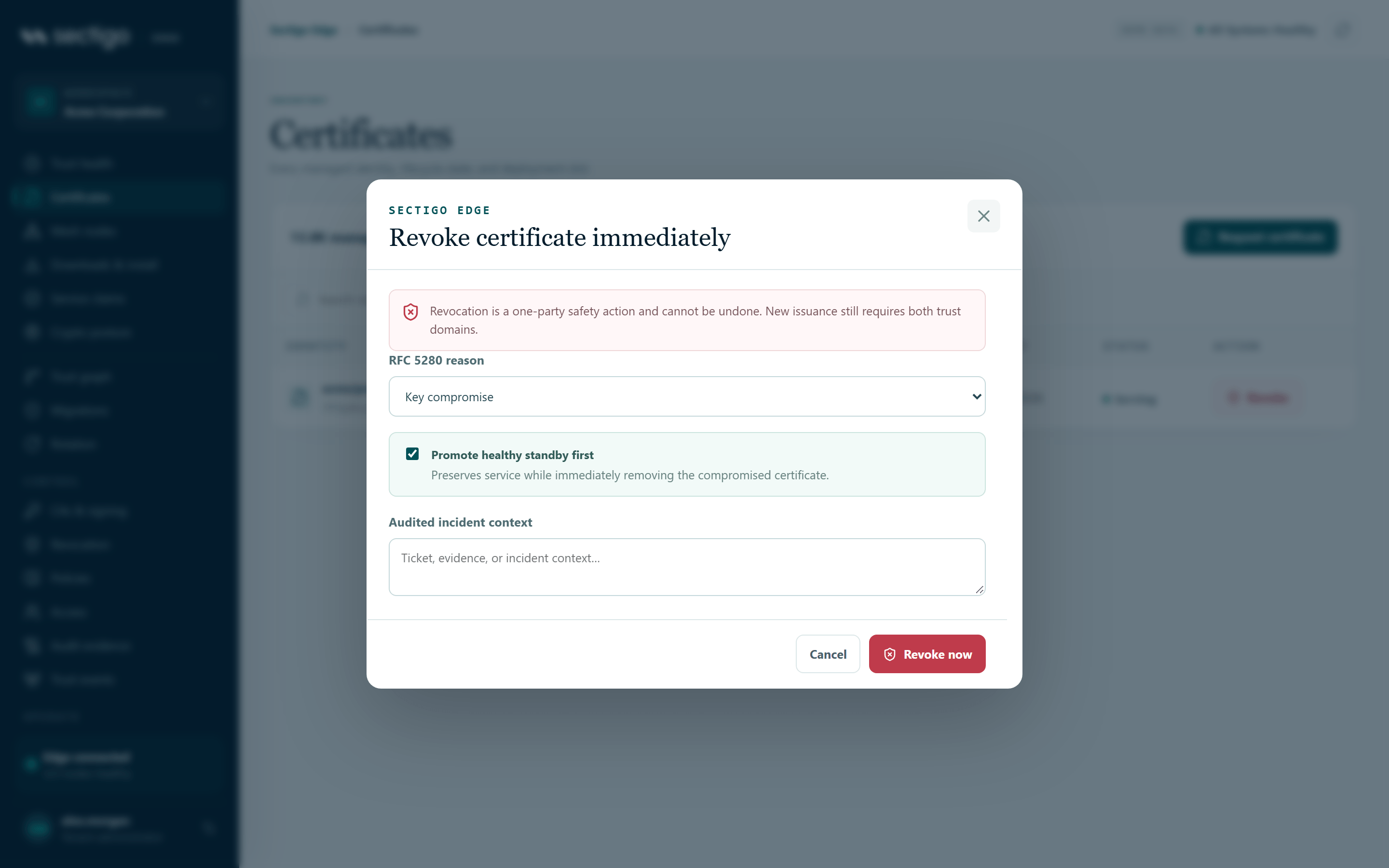
- Open ConsoleCertificates, find the certificate set, and select Revoke.
- Choose the RFC 5280 reason: Key compromise, Superseded, Cessation of operation, Affiliation changed, Privilege withdrawn, Certificate hold or Unspecified.
- If the set has a healthy standby, leave Promote healthy standby first selected. The service then keeps running on the standby while the compromised certificate is removed.
- In Audited incident context, enter the ticket, evidence or other context. It becomes part of the audit record.
- Select Revoke now.
You need revocation permission and fresh MFA. One person is enough: revocation removes trust, so it does not need a second approver. New issuance still needs both trust domains.
Revocation cannot be undone, and Certificate hold is no exception: you cannot release a held certificate from the console. If you need the service back, issue a new certificate.
Revocation still works while the issuance kill switch is active. Pausing issuance during an incident does not stop you from revoking.
What relying parties see
- CRL
- OCSP
Certificates issued through the built-in path carry a CRL distribution point of this form:
https://sharppki.com/pki/<tenant-id>/crl/<connector-id>.crl
- It answers
GETandHEADwithout a sign-in, because clients must be able to check status before they trust a certificate. - It always serves the latest committed CRL, with content type
application/pkix-crl. - Responses may be cached for at most one hour.
- When fewer than five minutes remain before the CRL's
nextUpdate, or storage is unavailable, the endpoint returns503. It never serves a stale CRL.
The OCSP responder lives at:
https://sharppki.com/pki/<tenant-id>/ocsp/<connector-id>
- It accepts OCSP
POSTand RFC 5019-styleGETrequests. - Responses are pre-produced for both SHA-1 and SHA-256 CertIDs, so older and newer clients both work.
- Cache headers come from the signed
nextUpdate. A response with less than five minutes left is never served.
Errors are returned as OCSP responses, not product JSON:
| OCSP status | When |
|---|---|
malformedRequest | The request is malformed or unsupported. |
tryLater | The certificate is recognized, but no fresh, verified response is published yet. |
unauthorized | The certificate or issuer is unknown to this responder. |
The responder serves a cache profile. Requests that are signed, that carry more than one CertID, or that include extensions or a nonce are rejected. Configure clients not to send OCSP nonces to this responder.
Publication cadence
| Event | CRL | OCSP |
|---|---|---|
| First successful issuance for an authority | CRL generation 1 is created, even if empty, so certificates never point at an uninitialized endpoint. | good responses are pre-produced for both hashes. |
| A certificate is revoked | A new CRL generation is requested immediately. | New revoked responses are published immediately. |
| Publication fails | The certificate stays revoked. Its publication status is pending. Retries start after 1 minute, then every 5 minutes. | Same: the revoked state is kept, and publication is retried durably. |
| Routine refresh | — | Each accepted response is refreshed one hour before its nextUpdate. |
Each CRL publication is checked independently before it goes live: signature, issuer, cRLSign key usage, freshness, every required serial, reason and time, and a strictly increasing CRL number. A refresh can never overwrite or renumber an earlier generation.
Monitor and refresh
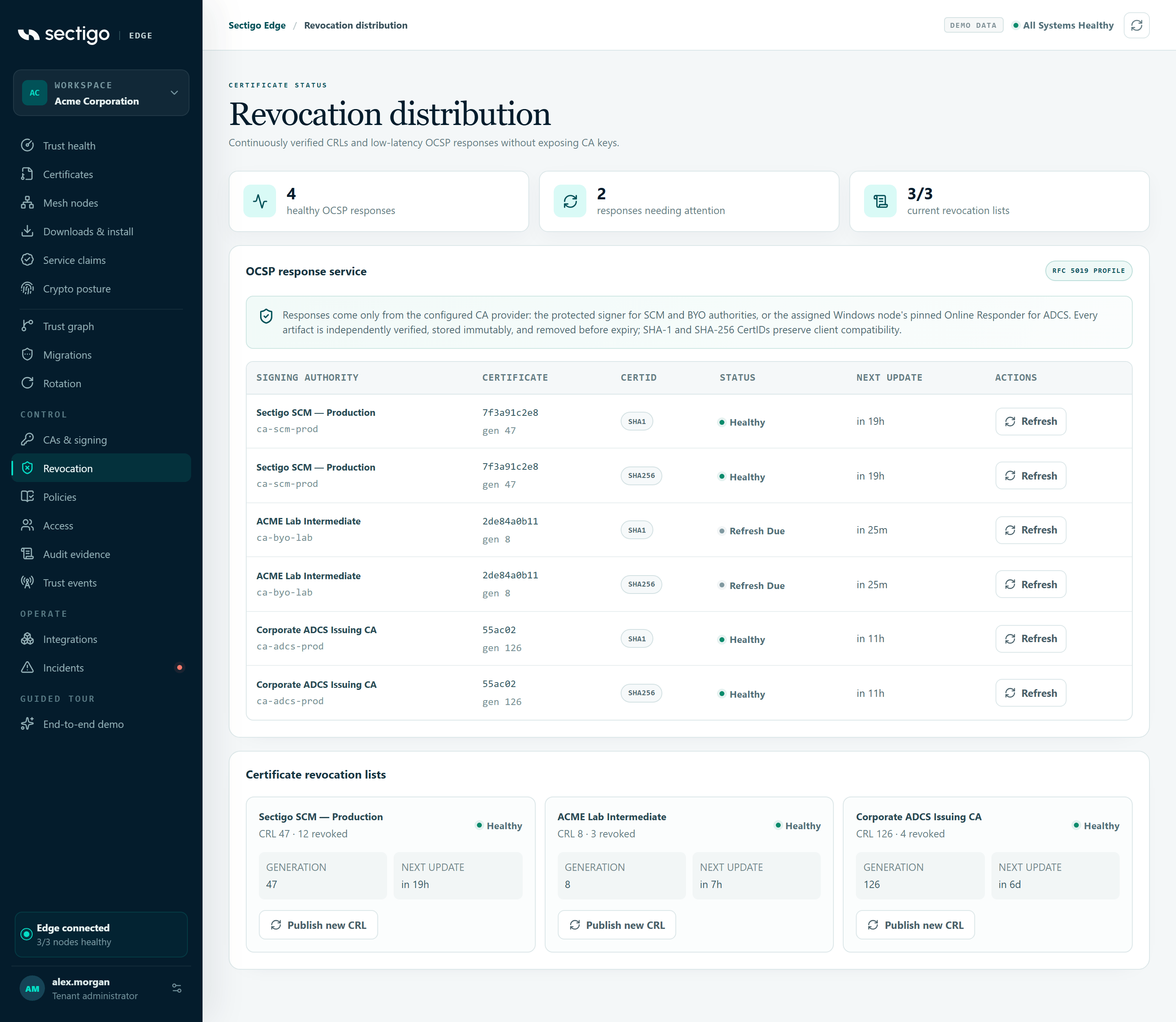
ConsoleRevocation shows:
- healthy OCSP responses, responses needing attention (
pendingorrefresh due) and current revocation lists - for each OCSP response: signing authority, serial, generation, CertID hash, status and next update
- for each CA: CRL number, number of revoked entries, generation, next update and status
| Status | Meaning |
|---|---|
healthy | A verified, current artifact is published. |
pending | Publication is waiting or being retried. |
refresh due (OCSP) | The response is near its refresh point. |
expired (CRL) | The latest CRL has expired. The public endpoint returns 503. |
external | Microsoft ADCS: the local CA has not yet produced an accepted artifact for the latest change. See below. |
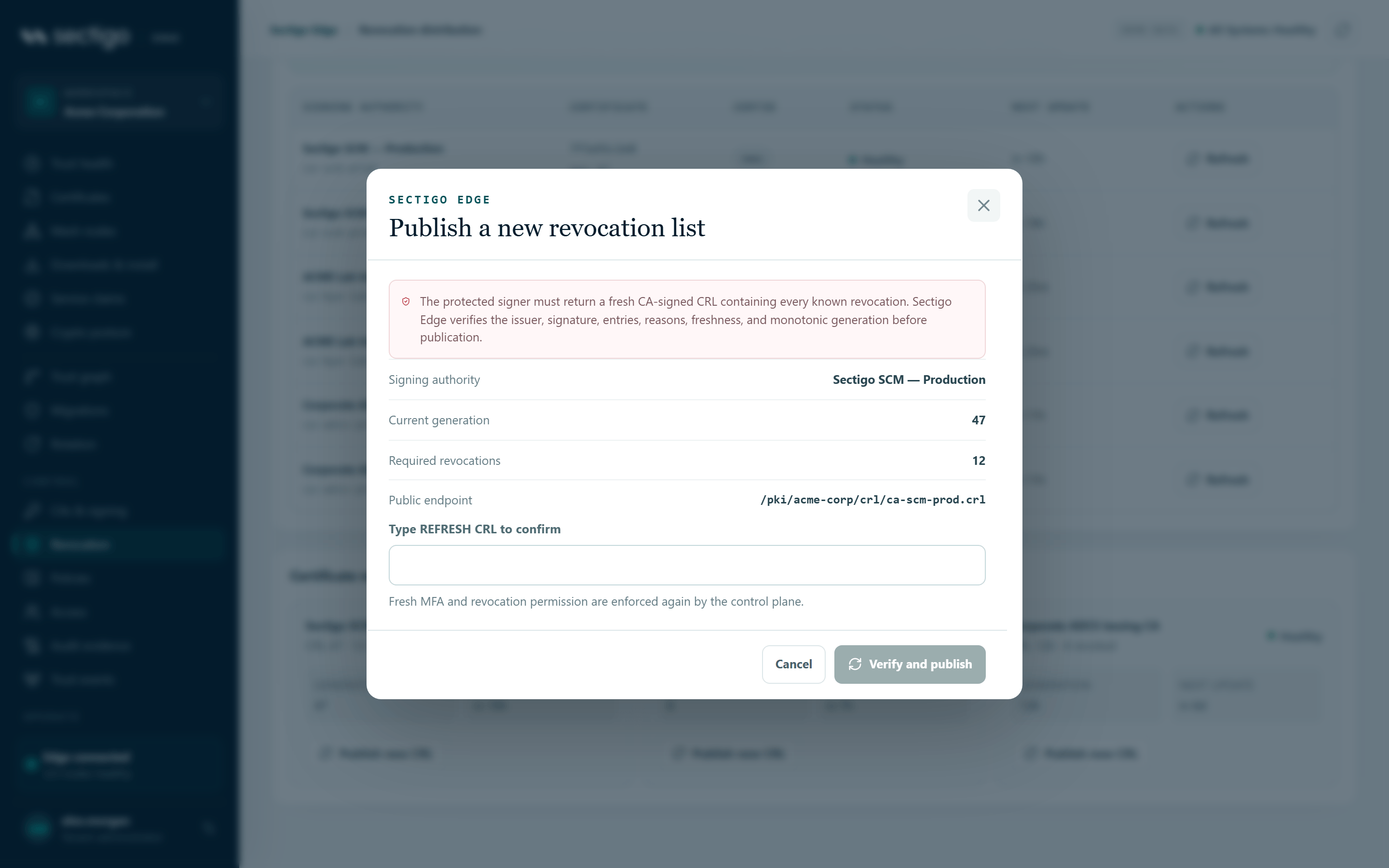
To force a new publication:
| Action | Where | Confirmation |
|---|---|---|
| Publish new CRL | The CA's card under Certificate revocation lists | Type REFRESH CRL |
| Refresh OCSP (or Queue, for ADCS) | The response's row in OCSP response service | Type REFRESH OCSP |
Both need revocation permission and fresh MFA, which are checked again on submit.
Microsoft ADCS
With Microsoft ADCS, your local CA stays the authority. A healthy Windows Mesh Node assigned to the ADCS integration publishes and retrieves the CA-signed CRL and gets OCSP responses from your configured Microsoft Online Responder. Sectigo Edge verifies these artifacts before it serves them. It never fabricates an ADCS CRL or OCSP response.
- The status shows
externaluntil the node uploads an accepted artifact. It then becomeshealthy. - Publish new CRL is disabled for ADCS authorities. The button shows Local CA managed.
- Publication requests survive node, CA and network outages and are redelivered.
- A successful ADCS CRL does not mean OCSP is working. They are tracked independently.
See Microsoft ADCS.
Verify revocation from a client
curl -sI https://sharppki.com/pki/acme-corp/crl/ca_prod_issuing.crl
HTTP/2 200
content-type: application/pkix-crl
curl -s -o latest.crl https://sharppki.com/pki/acme-corp/crl/ca_prod_issuing.crl
openssl crl -inform DER -in latest.crl -noout -nextupdate -crlnumber
nextUpdate=Oct 2 14:00:00 2026 GMT
crlNumber=0x2A
openssl ocsp -issuer issuing-ca.pem -cert service.pem -no_nonce \
-url https://sharppki.com/pki/acme-corp/ocsp/ca_prod_issuing
service.pem: revoked
This Update: Oct 1 14:00:00 2026 GMT
Next Update: Oct 2 14:00:00 2026 GMT
Reason: keyCompromise
Revocation Time: Oct 1 13:58:41 2026 GMT
Use -no_nonce. A request with a nonce is rejected by the cache profile.
Errors you may see
| Code | Meaning | What to do |
|---|---|---|
certificate_not_revocable | Only an issued certificate can be revoked. It may already be revoked. | Refresh the certificate list. |
invalid_revocation_reason | The reason is not recognized. | Choose one of the listed reasons. |
revocation_comment_too_long | The incident context is too long. | Shorten it, and link to your ticket instead. |
crl_context_required | The CA has not completed an issuance yet, so there is no CRL to publish. | Issue one certificate first. |
crl_expired (503 at the public URL) | The latest CRL is expired or too close to expiry. | Select Publish new CRL. If it keeps failing, check the CA connection. |
crl_partition_required | The CA has more than 50,000 active revocations. | A partitioned CRL configuration is needed. Raise it with your Sectigo Edge platform contact before the CA reaches this limit. |
remote_crl_publication_failed / remote_ocsp_publication_failed | The protected signing service rejected the publication. | Retry. If it persists, check the CA connector under ConsoleCAs & signing. |
crl_publication_raced / ocsp_publication_raced | Another publication changed the generation at the same moment. | Retry. Generations are never overwritten. |